Solve Salesforce deployment errors
- Reading the deployment job log
- Metadata errors
- Test classes errors
- Code coverage errors
- SOS, I am lost
Solve deployment errors
Reading the deployment job log
At the end of a deployment or a deployment check, sfdx-hardis displays a short summary instead of the complete Salesforce deployment response, which can be several hundred thousand characters long on big orgs.
Deployment check summary for calculated-package-xml
  Status: Succeeded
  Deployment ID: 0AfG500000PCMG6KAP
  Deployment mode: DELTA
  Components: 26 deployed, 0 failed (26 total)
  Apex tests: 465 completed, 0 failed (465 total)
  Org-wide Apex coverage: 86.82%
  Duration: 0:39:24.000
  Full deployment JSON: hardis-report/deploy-result-calculated-package-xml.json (published in CI job artifacts, hardis-report folder)
  Define NO_TRUNCATE_LOGS=true to display the full deployment JSON in the console again
Deployment errors, failed Apex tests and deployment tips are still displayed in full below that summary.
Full deployment JSON
The complete deployment response is written in the report directory (hardis-report by default), as deploy-result-<package label>.json, on success and on failure. It contains the component successes, the Apex test details, the coverage details and every other field returned by the Metadata API.
The CI/CD pipelines generated by sfdx-hardis publish that folder as a job artifact. If your repository was created before this feature, add the artifact publication to your existing pipeline:
| Platform | Add to the deployment job |
|---|---|
| GitLab | artifacts:when: alwayspaths:- hardis-reportexpire_in: 1 week |
| GitHub | A step using actions/upload-artifact@v4 with if: success() \|\| failure() and path: hardis-report |
| Azure Pipelines | - publish: $(System.DefaultWorkingDirectory)/hardis-report/condition: succeededOrFailed()artifact: hardis-report |
| Bitbucket | artifacts:- hardis-report/** |
| Jenkins | Already archived by the default Jenkinsfile |
To get the complete JSON back in the console, define the environment variable NO_TRUNCATE_LOGS=true on the job.
Metadata errors
sfdx-hardis displays each error with a tip about how to solve it. When the project has AI features configured, the Deployment Agent also explains the error and proposes a fix.
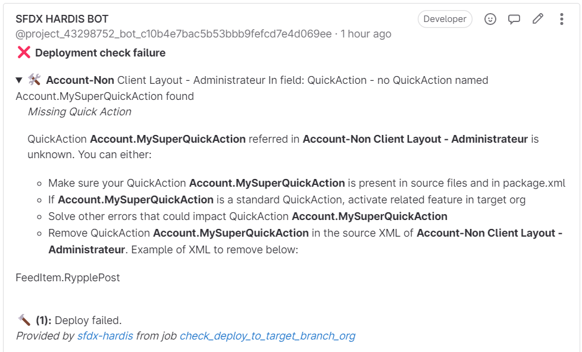
Fix with a new commit
Solve the issue in your org or in your local files, create a new commit, and run  again. The validation jobs run again on the new commit.
Fix with reset commits then a new commit
If the error comes from files that you committed but finally do not want to publish, you can reset your selection.
- Click
 : it rolls back all the previous commits of your current git branch, without losing your local files.
- Stage and commit again only the elements that you want to publish.
- Run .
Test classes errors
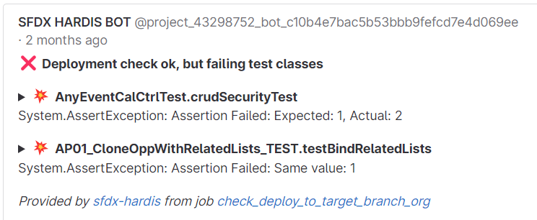
Fix the test classes: read the error message of each failed test, it usually tells which assertion or which record creation failed.
If you are an admin, you might need the help of a developer, who can work directly in your branch.
Code coverage errors
Write the missing test classes. You will need them anyway to deploy to production, and the sooner they exist, the easier they are to write.
SOS, I am lost
- Read the tip sfdx-hardis adds under each error. The Deployment Agent knows the most common Salesforce deployment errors and explains how to fix them.
- Ask your release manager, they are here to help you.
- Search Salesforce StackExchange for the error message.
- If you think the error is caused by sfdx-hardis itself, or if its tip is wrong, open an issue on GitHub.